There’s a lot of focus placed on how much sunlight a plant needs to grow. But some plants don’t grow well when planted in sunlight. They may even droop when they receive too much sun.
If you’re looking for shade-loving plants for the shady spots in your New York garden, here are 7 plants to consider.
1. Stinking Iris
Stinking iris plants have clusters of glossy, sword-shaped leaves. It’s a hardy plant with fragile light blue flowers that bloom in the summer. In the fall, the plant’s orange-red seeds become exposed when the seed pod opens.
Although it tolerates full shade and prefers partial shade, this plant grows well in full sunlight. Plant stinking iris in moist humus-rich soil that drains well.
Once established, stinking iris plants have no problem surviving in rainy and dry climates with or without full shade.
Stinking iris is the perfect accent plant for cottage gardens, flowerbeds, and along landscape borders. It also looks great when planted under shrubs and near roses.

2. Snowdrop
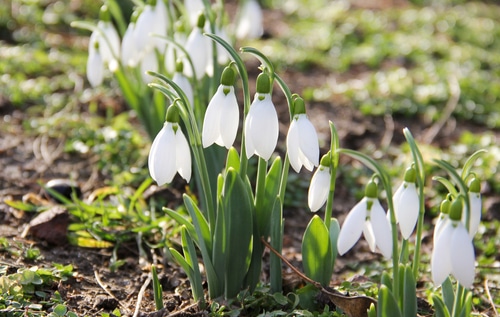
You may be interested to learn that the snowdrop plant is a member of the onion family. This low-maintenance perennial has 1-inch bell-shaped white flowers that hang from the plant’s stems like a water droplet before blooming.
Snowdrops prefer full shade but can tolerate sunlight. For best results, plant snowdrops in moist, humus-rich soil that’s loose and drains well. It doesn’t need very much water when planted in cooler climates, but it will need more frequent watering if planted in warmer areas.
Snowdrops are perfect for rock gardens since they are small. They are also a perfect fit for moon gardens and in wooded settings where their white blossoms can illuminate the area at night.
3. Monkshood
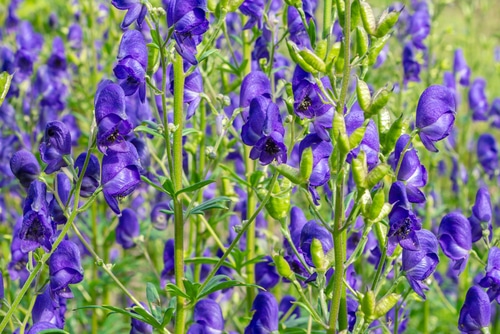
The monkshood plant is a perennial herbaceous wildflower that can be found growing in mountain meadows. This moderately slow-growing flower has smooth leaves and deep blue or purple and white flowers that have a hooded appearance when they bloom in midsummer.
Monkshood plants prefer the sun but can tolerate some shade. It grows well in moist, well-drained soil. Carefully monitor the richness of the soil before planting; if it’s too rich, the plants will become leggy. In addition, too much water can damage its roots.
4. Foxglove
Foxglove plants are often used to add height to gardens. Their stems grow to be 2 – 5 feet tall and they produce lovely funnel-shaped pink, white, or purple flower blooms. Foxglove plants grow leaves at their base when they’re first planted; they bloom during their second season.
Depending on how warm it is, foxgloves can tolerate full sun, medium shade, or full shade. In extreme heat, they benefit from extra midday and afternoon shade. Plant foxglove plants in rich, moist, well-draining soil to maximize their growth and blooms.
Foxglove plants look great in all gardens, in flowerbeds, along landscaping borders, and in planters.
5. Toad Lily
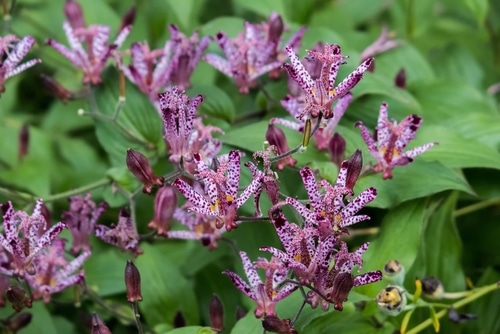
Toad lilies give a stunning, exotic touch to any shady spot. These unusual lilies have vivid white and purple speckled flowers that bloom in late summer. As with orchids, toad lilies grow tall, arching stems.
Toad lilies are fairly simple to maintain if they are planted in partial to full shade. These flowers like moist, loamy, well-draining soil that has a slightly acidic pH level.
Plant toad lilies where you and others can appreciate their unique blooms every day, such as along landscaping borders or small streams or ponds. They’re also great along a walkway or sidewalk.
6. Japanese Painted Fern
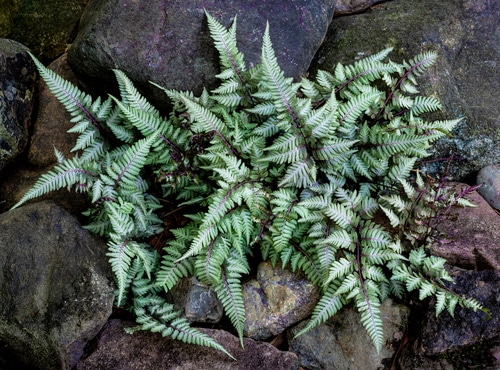
The vibrant Japanese painted fern can also liven up shady portions of any garden. As its name suggests, the Japanese painted fern is a colorful fern; it has silvery variegated fronds with grayish-green and purple mid-ribs.
Japanese painted ferns can be planted in partial to complete shade depending on how hot it gets outside. The fronds must be shielded from intense sunlight to prevent damage. Plant it in soil with adequate drainage.
The Japanese painted fern is ideal for use as a border plant or to add color to a planter. They are also good plants to use for erosion control and in gardens.
7. Boston Ivy
The Boston ivy is a climbing vine that clings to nearly everything it touches. This ivy’s leaves turn crimson in early spring before becoming green in the summer. The leaves return to a reddish hue in the fall.
Boston ivy thrives in New York’s climate. Grow these vines in medium shade to full sun. While it may tolerate complete shade, Boston ivy requires full sunlight to attain optimal autumn color. Boston ivy grows best in well-drained, loamy soil with a pH between 5.0 – 7.5.
Consider growing Boston ivy along garden arbors, pergolas, and fences. You can also plant them near a trellis, particularly if you’re looking for its leaves to provide a privacy screen for your yard or patio.