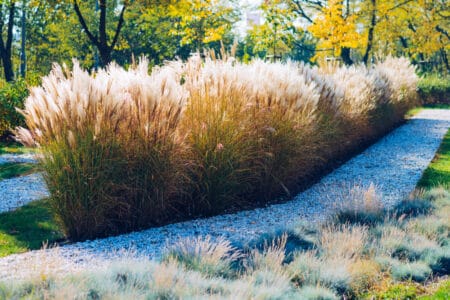
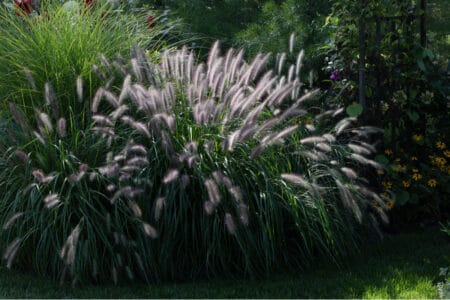
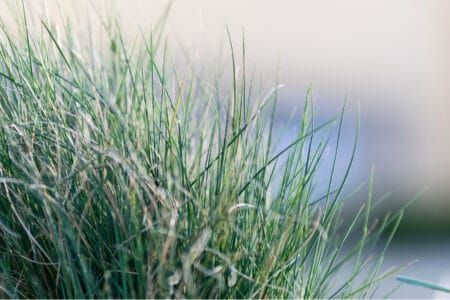
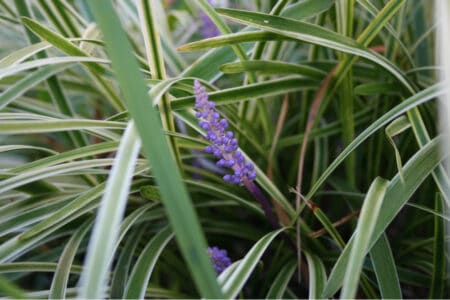
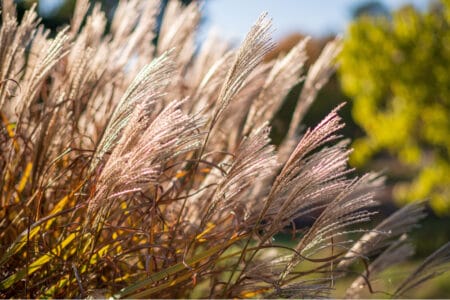
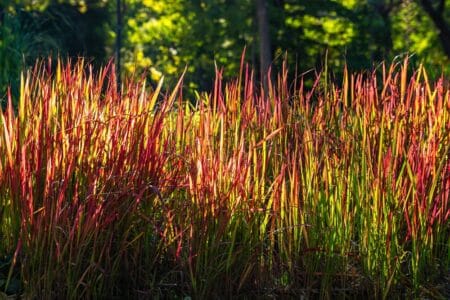
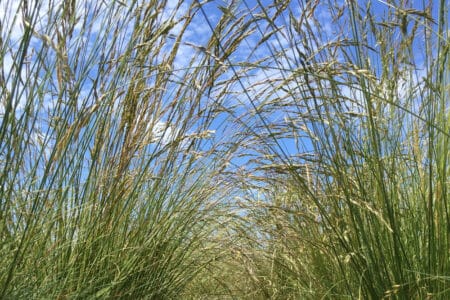
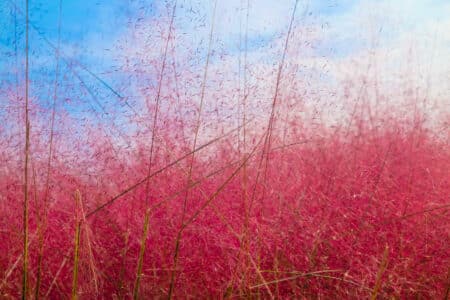
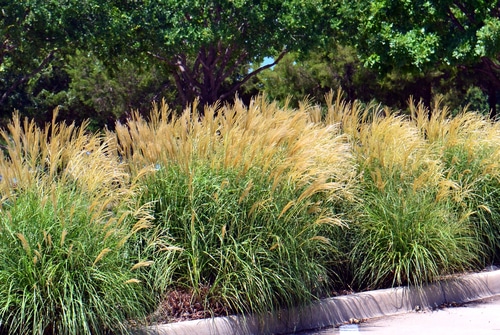
While most grasses produce flowers, miscanthus are among those that draw the most attention because of their beauty. They have erect, airy flower plumes and range from pale silver, to buff, to deep purplish-red in color, depending on the specific variety.
Keep reading to learn more about this grass that retains its beauty well into the winter and provides a charming and architectural display.
General Information
Miscanthus sinensis, often known as Chinese silver grass, Japanese silver grass, or eulalia grass, is a warm-season clump-forming grass that grows 3 to 7 feet tall.
It was originally found in the plains and lower alpine regions of Japan, Korea, and China. It has spread from gardens to over 25 states east of the Mississippi River and various western states, including Colorado and California.
Is Miscanthus Invasive?
Miscanthus sinensis is an invasive species in the landscape that thrives in warmer areas. It typically begins in disturbed environments like roadside ditches, railroad tracks, or woodland borders.
Despite being labeled as invasive in 25 states, miscanthus remains a popular nursery plant. Many individuals continue to believe that certain cultivars are sterile and incapable of producing viable seeds.
Yet studies have shown that almost all miscanthus create some degree of viable seed and therefore have the potential to be invasive.
The only miscanthus species that do not create viable seeds are miscanthus giganteus and miscanthus sinensis “Hinjo,” “Silberpfeil,” and “Cabaret.” So if you are set on growing miscanthus sinensis, consider one of these.
Care and Maintenance
Chinese silver grass prefers moist soil but is tolerant of anything from well-draining, sandy soil to heavy clay.
It can be grown in full sun or part shade. The less direct sun it receives, the less vigor and flowering the plant displays, with a tendency to flop in too much shade.
Foliage should be left standing throughout the winter for visual interest and crown protection. In late winter, just before new shoots appear, cut all foliage close to the ground.
As stated earlier, this grass will reseed to the point of being somewhat invasive in the milder parts of its growing range. Mulch helps prevent reseeding. Alternatively, buy a truly sterile species.

How to Use It in Landscapes
Miscanthus sinensis is a very versatile ornamental grass.
It can be used as an accent, specimen, or small grouping. Chinese silver grass can be incorporated into borders, meadows, wild gardens, cottage gardens, naturalized areas, or pond/water garden peripheries.
Alternatives to Miscanthus
If you want to grow something that adds beauty to your garden without having to worry about an invasive species, consider the following plants.
Switchgrass
Switchgrass is native to the entire United States, with the exception of California and the Pacific Northwest. It’s a perennial bunch grass that grows 3 to 5 feet tall and has short, vigorous rhizomes that can spread. The stem is circular and might be red or straw in color. The seed head is an open and spreading panicle. When planted on suitable soils, switchgrass is climatically suited to much of the United States.
Indian grass
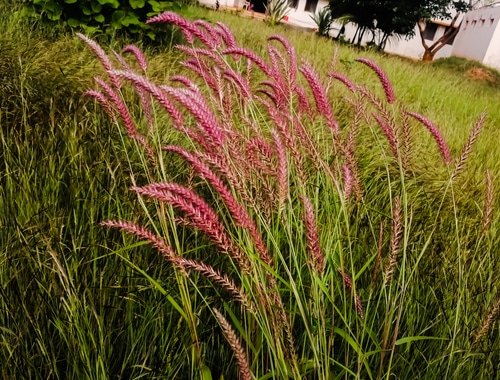
Sorghastrum nutans, sometimes known as yellow Indian grass, is a Poaceae family perennial grass that is an important component of the North American tallgrass prairie. Indian grass is a sod-forming plant that can reach great heights. Its fibrous roots reach a depth of 6 feet. In the autumn, the erect clumping blue-green leaves become yellow-orange. This plant’s flower clusters are tiny and densely branching.
Junegrass
Prairie junegrass can grow in the wild throughout much of North America. This adaptable grass can be found in the Plains Mountains, meadow slopes, and woodlands. Junegrass is a tufting true grass that grows in the chilly season. It can grow to be 1/2 to 2 feet tall and has thin flat leaves. The seeds are grouped in thick spikes of various colors ranging from pale green to light purple. The grass is so adaptable that it can grow in both sandy and compacted soils. This prairie grass blooms in June and July, which is earlier than most other prairie grasses. Seeds are produced until September.
Little Bluestem
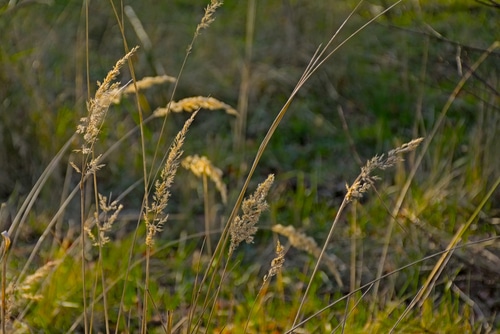
Little Bluestem is a perennial grass native to North America that grows up to 3 feet tall. It’s a short-medium prairie grass that’s one of the most common grasses in the wild. It’s also an excellent grass for attracting wildlife since a wide range of helpful insects feed on the leaves. It also attracts