Vanda orchids are among the handful of orchids that produce blue, fragrant flowers. The flowers have distinct flat petals, but their rambling roots make them truly unique from other orchids.
They originated in the tropical regions of Asia. Most Vanda orchids prefer to grow in warm areas with full sun. In colder climates, they are often grown year-round in greenhouses but are usually brought outdoors during the summer.
1. Vanda sanderiana
Vanda sanderiana (Waling-Waling) is a tall, upright epiphytic orchid with many aerial roots. They have long-lasting flowers and short, strap-shaped leaves. Their pink flowers are held on tall spikes throughout the winter and spring.
Waling-Waling produces 7 to 10 fragrant flowers in the fall. In tropical locations, they can bloom all year. It grows naturally on trees and requires indirect bright light to thrive. They do well in hanging baskets as long as the air stays humid.
Water thoroughly in the summer but less frequently in the winter. Ensure adequate circulation around the roots because they should dry in between watering.

2. Vanda miniata
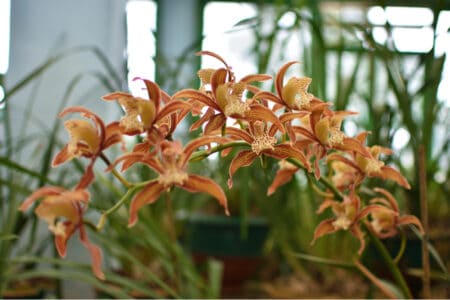
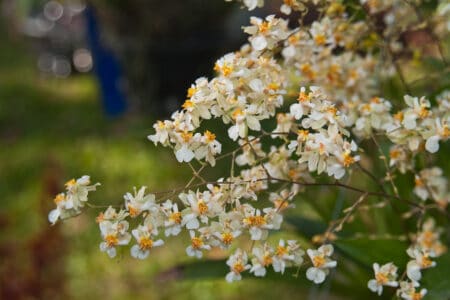
Vanda miniata (miniature vanda) has yellow to orange-red flowers that are about half an inch in diameter and are held on tall racemes. The lip features small, triangular side lobes.
The Miniature Vanda is a monopodial epiphyte that can grow 2 to 6 inches tall. The linear, fleshy, and thick leaves are alternately arranged along the stem. They can grow up to 5 inches in length.
This orchid is indigenous to the Philippines, Java, Sumatra, and Malaysia.
3. Vanda bensonii
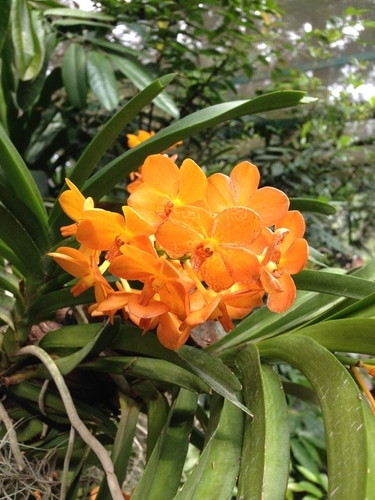
Vanda bensonii (Benson’s vanda) is native to India, Myanmar, and Thailand. It is a scarce species frequently used as a parent in hybrids.
Benson’s vanda produces ten to twenty fragrant, 2-inch-wide flowers in the spring. This plant has beautiful rust-brown flowers with tessellations or tilings on the petals. The lavender lip is also attractive.
This orchid grows best in hanging baskets in warm, bright light.
4. Vanda coerulea
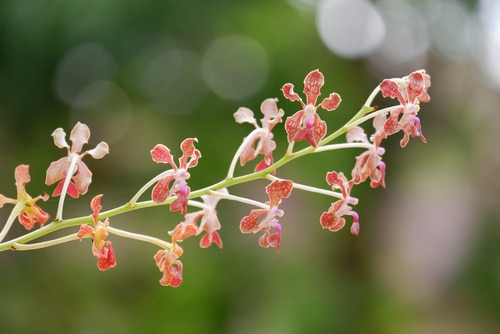
The blue vanda is the only orchid that produces almost true blue flowers. The colors range from ghostly pale blue or lavender to deep midnight indigo. Although some varieties also have white and pink flowers.
Blue Vanda orchids were discovered in Northeastern India, despite being native to China, Thailand, and Myanmar. These orchids bloom for a long time and offer therapeutic and cosmetic properties.
Blue orchids are extremely rare in nature, and collecting ones growing wild is illegal.
5. Vanda tricolor
The soft vanda is native to Java and Bali. This species has large, hot-growing stems and is an epiphyte, lithophyte, or terrestrial. The flowers feature red-brown specks on a white backdrop, although occasionally yellow or red spots cover the whole surface
The leathery leaves range from 13 to 18 inches long and 1.5 inches wide. The orchid produces six to nine big, fragrant flowers around 2 to 3 inches wide.
These plants like full sun but prefer partial shade during the hot summer.
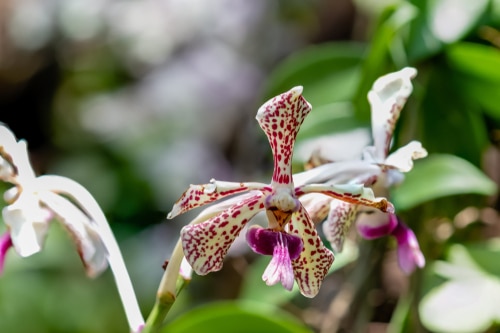
6. Vandopsis lissochiloides
Vandopsis is Greek for vanda-like. The Vandopsis lissochiloides have the physical characteristics and growing requirements of Vanda orchids.
Vandopsis lissochiloides is a large terrestrial orchid that grows in Thailand, Indonesia, and the Philippines. They can take up much space, but their beautiful flowers and long lifespan are worth it.
The inflorescence of a mature plant can grow to be 6 feet long. The plant blooms in the summer with 20 to 30 yellow flowers, with brown or purple streaks lasting 3 or 4 months.