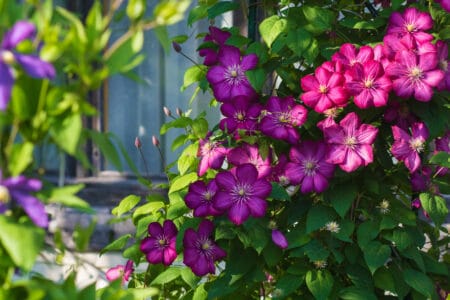
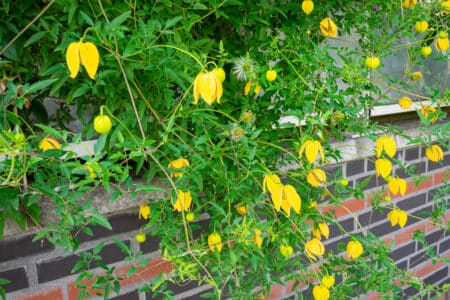
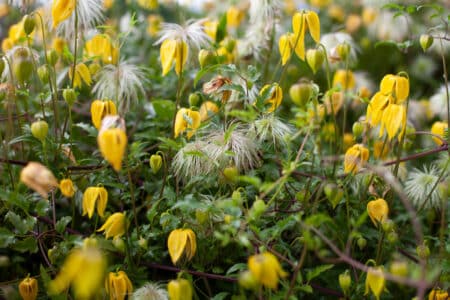
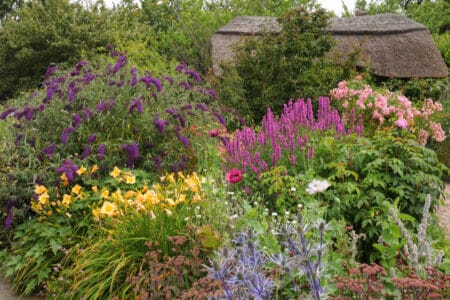
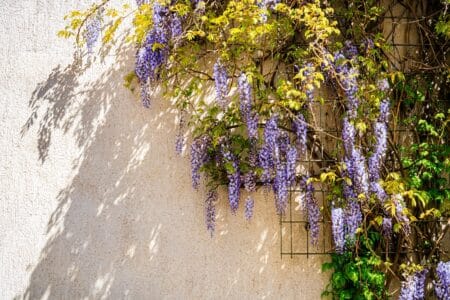
The clematis is also called the “Queen of Climbers.” In the summer, it will joyfully climb over trellises, over arbors, and between other plants to form a colorful tapestry. It’s easy to fall in love with clematis, and it’s wonderful to discover new ways to incorporate them into your garden.
There is a wide variety of colors to choose from when it comes to the star-shaped blooms. This article will focus on red-colored clematis and how to cultivate them. Read on to find out more.
1. ‘Rebecca’
‘Rebecca’ is a very showy variety and is destined to become a garden mainstay. This manageable perennial vine grows 6 to 8 feet tall and blooms in late spring to early summer with gorgeous, 5- to 7-inch-wide crimson flowers with creamy yellow anthers. The blossoms are so numerous that they almost completely obscure the leafy greenery.
This variety is a member of the second group of clematis, which blooms in the early summer on young stems that have grown during the previous year. Some flowers may appear on fresh growth in the late summer. To keep the plant healthy and vigorous, clip the vine before new growth begins in late winter or early spring and after the initial flush of early summer blossoms.
This variety grows readily and does well in damp, well-drained soil. It thrives in Zones 4 to 9, enjoys full sun to moderate shade, and is resilient. Its compact design makes it perfect for tiny gardens and containers. You can also train it to develop into little bushes.

2. ‘Rouge Cardinal’
‘Rouge Cardinal’ is a robust, large-flowered cultivar with velvety, bright crimson blossoms that measure 4 to 6 inches, with beautifully recurved sepals and contrasted ivory stamens. It never fails to dazzle.
This variety is part of the third group of clematis, which encompasses the late-blooming cultivars. It begins to bloom on new growth in the middle of the summer and then again on new shoots at the beginning of the autumn. Plant ‘Rouge Cardinal’ in full sun to promote the purest crimson color. Any shadow will add purple tones to the blossoms. Even so, the color and size of the flowers may change as the vine ages. Keep the light shining on the flower’s crown and keep the roots cold and sheltered.
‘Rouge Cardinal’ will grow on trellises, fences, or entryway arches. It is stunning whether grown alone or combined with other colors.

3. ‘Charmaine’
Clematis ‘Charmaine’ is a climber with twining leaf stalks and spectacular blossoms. It may be either an evergreen or a deciduous shrub. All summer long, beautiful dark red blooms with gently ruffled petals bloom in single, semi-double, and double forms. In the fall, some flowers will grow lovely, fluffy seed heads.
Because this vine belongs to pruning group 2, it blooms on both old and new growth every year. ‘Charmaine’ thrives in sun to partial shade with at least 6 hours of sunlight each day. It needs cold, moist roots, which you can provide by surrounding them with flat stones or planting annuals at the base.
A showstopper for smaller gardens, pots, and containers, it blooms from late spring to early fall.

4. ‘Kermesina’
‘Kermesina’ blooms a deep crimson color from July to early October. This variety is a very hardy, large, free-flowering deciduous climber. It features single, dark red flowers with up to four sepals, blotches of white at the base, black stamens, some with green tips, and up to four sepals in width.
‘Kermesina’ falls within the third group of clematis. These are the late-flowering varieties. They start to bloom on new growth in the middle of the summer, and then they bloom once more on new shoots at the start of the fall. ‘Kermesina’ thrives in full sun to moderate shade requiring at least 6 hours of direct sunshine each day. The roots, though, need to be kept cool and wet.
The scarlet blooms are magnificent as they climb up trees, shrubs, and climbing roses. This variety got its name because the flowers resemble the kermes bug, from which the red dye cochineal is derived.
5. ‘Rosemoor’
Extremely long blooming, ‘Rosemoor’ blooms from May to September with rich reddish-purple blossoms on both the current and previous season’s growth. The central stamens of the 5- to 6-inch-wide flowers have a striking golden color.
This plant is a member of the second group of clematis, which blooms in the early summer on young stems that have grown from the previous year. Before new growth begins in spring, they should be clipped in late winter or early spring.
‘Rosemoor’ does well in full sun and wet, well-drained soil. While the vine can tolerate dappled shade, the plant likes to have “its head in the sun and its feet in the shade.” So, keep the roots cool and sheltered by adding rocks or other plants around the base of the vine.
This variety provides vertical beauty by gracefully winding over fences, trellises, or bushes.

6. ‘Texensis Gravetye Beauty’
‘Texensis Gravetye Beauty’ is a hybrid that generally grows to a height of 12 feet. The blossoms are shaped like lily-flowered tulips, with 4 to 6 sepals. They feature faint pink lines along the exterior margins and are ruby red inside and out. Red anthers are set against white filaments.
This variety is part of the third category of clematis—the late-flowering cultivars. It needs hard pruning and should be trimmed in the late winter. ‘Texensis Gravetye Beauty’ grows best in full sun or partial shade, in wet, well-drained soil.
Strong and prolific, it creates a lovely groundcover when paired with big, rambunctious, climbing, or shrub roses.
7. ‘Nubia’
The ‘Nubia’ clematis is completely covered with deep red blossoms from June through August and once more in September! The plant stretches out to a width of approximately 2 feet, and the stems are covered with blossoms and deep green foliage. It grows well Hardiness Zones 4 to 9.
This variety is a member of Clematis Group 2, which means that blossoms develop on the previous season’s growth. Swollen leaf buds start to emerge in the early spring.
This clematis requires sunlight—at least 4 hours every day—but thrives when its roots are protected from the heat. It requires rich to medium-rich, well-draining soil.
The vivid crimson blossoms on this clematis will attract butterflies and hummingbirds. The vine grows well on posts, trellises, or in pots next to a patio or window. This clematis creates a striking curb appeal.