Flowers come in many shapes, textures, and colors. There are flowering plants suitable for any climate, including New Jersey.
Flowers are grown throughout the growing season and add color and fragrance to any yard. Purple is a common and desired color for flowers. Let’s take a look at a few purple blooming plants suitable for your New Jersey garden.
1. Periwinkle
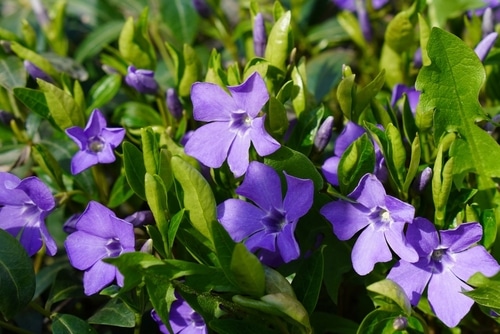
Because it is excellent at controlling erosion, the common periwinkle plant (Vinca minor) is frequently spotted creeping down steep slopes and banks, giving otherwise desolate areas a green and flourishing appearance.
Periwinkle is also known as creeping vinca and creeping myrtle. The plant gets its name from gorgeous blue, purple, or white flowers. Periwinkle comes in over 30 varieties, some of which have variegated leaves and varying flower colors.
Periwinkle emerges in the spring and adorns with beautiful foliage. It is grown as a spreading shrub in USDA garden zones 4 to 8.
2. Spiderwort
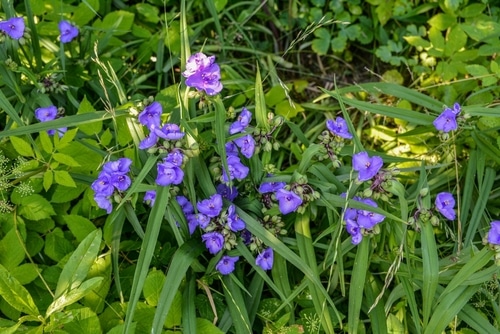
Spiderwort (Tradescantia virginiana) blooms are easy to grow and maintain. The flowers of the three-petaled spiderwort can be pink, white, red, or blue to purple.
The flowers will bloom for up to four to six weeks in the summer; however, they will only be open for one day in the morning. The foliage of the plant is made up of grass-like leaves that arch.
Spiderwort plants grow in clusters, ideal for use in borders, edging, woodland gardens, and even containers.
3. Creeping Speedwell
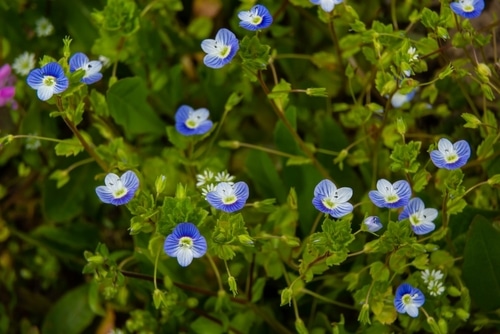
Creeping speedwell, also known as Veronica filiformis, is a perennial ground cover with dainty four-petal flowers that come in pink, blue, and purple. The plant grows and spreads quickly up to 30 inches wide, with a maximum height of 5 inches.
Creeping speedwell is a non-native plant from Asia and Europe. It is easy to care for and can frequently be found growing in the wild. The plant grows best in partial shade in warm climates but will grow in full sun in cooler areas.
4. Purple Coneflower
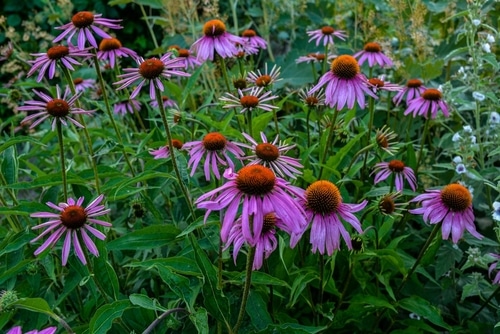
Echinacea purpurea is native to the Eastern United States. A constant summer bloomer that draws bees, butterflies, and pollinators to your garden, purple coneflower can reach heights of 5 feet.
Like all coneflowers, the purple variety can handle just about any growing conditions. It grows well in poor soils and is drought tolerant. Applying fertilizer is rarely necessary though it can help increase bloom size.
5. Passionflower (Passiflora ssp.)
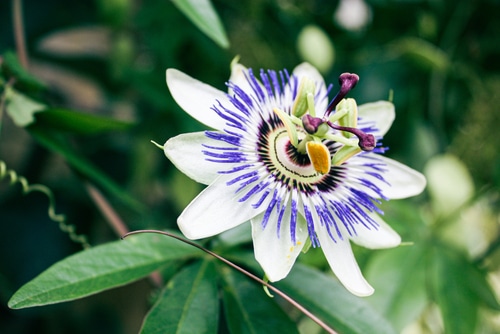
Passionflower (Passiflora incarnata) comes in various types, including shrubs, annuals, perennials, and trees. More than 500 species fall under the genus Passiflora, native to North and South America.
The plants have a tropical appearance but can be successfully grown anywhere, including in colder regions. Passionflowers grow quickly and are best planted in the early spring or fall when the weather is still mild. They can range in heights from 6 to 30 feet.
The vining varieties are often trained to climb a trellis, fence, or other vertical structure in areas where passionflowers are considered hardy.
6. Bachelor Button (Centaurea cyanus)
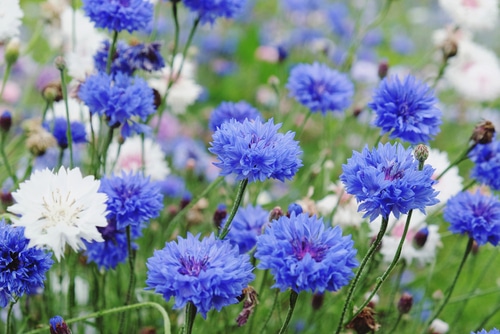
Bachelor button flowers, also known as cornflowers, are a classic plant you probably remember seeing in your grandparent’s garden. They require little upkeep and thrive in direct sunshine. In addition to the traditional flower color of bluish-purple, the flowers also come in red, white, and pink.
Annual bachelor button plants feature single or double flowers. Bachelor buttons, once established, will thrive season after season since they easily reseed. Though not currently listed as a noxious weed, bachelor buttons may be invasive.
7. Allegheny Monkeyflower (Mimulus ringens)
Monkey flowers provide long-lasting color and appeal in moist or wet garden settings, such as marshes, stream banks, and damp meadows. The flowers bloom from spring through fall.
Mimulus ringens flowers have two lobes on the upper petal and three on the lower. The pale blue-violet flowers resemble faces. Monkey flower care is straightforward as long as they have plenty of moisture; they thrive.