Clematis is often regarded as the most beautiful of all climbers. This easy-to-grow perennial has vining stems that will joyfully climb up trellises, across arbors, and through other plants to create a tapestry of color throughout the summer months. Gardeners worldwide love this plant, and it can be a lot of fun to discover new ways to incorporate it into the garden and other outdoor spaces.
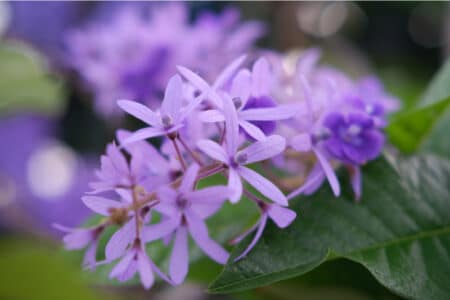
The star-like flowers bloom in colors of white, pink, red, blue, or purple. Here, we will focus on purple-colored clematis and some essential tips when growing them. Read more to find out!
1. Jackmanii
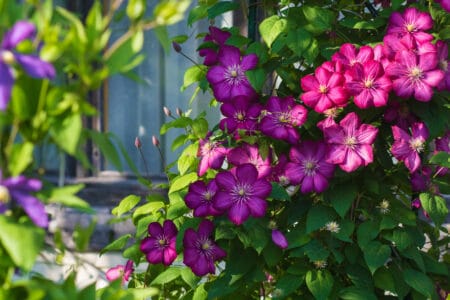
The best-known clematis in the United States is a prized gem. The clematis jackmanii impresses with a profusion of 5- to 6-inch-wide velvety, dark purple flowers. As the blossoms age, they gradually become violet and contrast beautifully with the greenish–cream anthers. Jackmanii blooms on both old and fresh wood.
While it may tolerate some shade, jackmanii flourishes in direct sunlight. It needs at least 6 hours of bright light each day. Like all clematis, jackmanii needs plenty of water when initially planted and as it grows. The plant likes damp soil, but when adequately mulched, it doesn’t need much watering.
Jackmanii belongs to the third group of clematis, which is a group of clematis that bloom in the late summer on growth produced during that season. It is a great choice for trellises; it can be taught to climb a wall, fence, or arbor; and works well in containers.

2. Sweet Summer Love
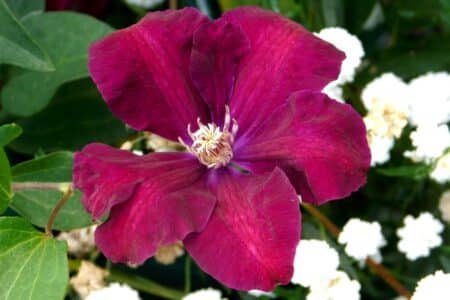
‘Sweet Summer Love’ grows 10 to 15 feet tall and 6 to 10 feet wide with an erect and vining habit and tiny leaves. It produces many 1- to 2-inch-wide cranberry red blooms that mature to reddish-purple and have a cherry or almond-vanilla aroma.
‘Sweet Summer Love’ belongs to the third group of clematis that blooms late in the summer. Grow it in broad sun to partial shade on rich, medium moisture-content, well-drained soils. The best location provides shade for the roots and full sun for the flowering parts of the plant. In hot and humid summer regions, a little midday shade prevents sunburns.
‘Sweet Summer Love’ will scale walls, trellises, fences, arbors, porches, lampposts, and other fixed objects. It provides modest gardens with excellent architectural height and structure. In addition, it can be positioned to cover the ground, climb over old stumps, or just spread over and among other blooming perennials and annuals.
3. Jolly Good
The green foliage of the ‘Jolly Good’ clematis contrasts well with its light purple flowers. This shrub provides a profusion of blooms that last the whole summer. This variety spreads out to a height of 24 to 36 inches and a width of 72 to 84 inches. If pruning is needed, do it in the spring when the new growth starts to appear. Because this vine blooms on fresh wood every summer, it belongs to clematis pruning group 3.
It’s easy to take care of your ‘Jolly Good’ clematis. It needs at least 4 hours of sun each day, so it should be planted in full-sun to part-sun locations. It requires well-drained soil and although it may grow in any type of soil, it should be cold and wet.
‘Jolly Good’ is a sturdy bloomer and compact vine. Train this hybrid to grow on your fences and trellises for a stunning show throughout its abundant summer blooming period.

4. Sparky Purple
The ‘Sparky Purple’ clematis will easily enhance the beauty of your landscape. Lighthearted, spinning, twirling, 2-inch blooms nod among the medium-green leaves. The fuchsia-colored buds become violet-purple flowers that face downward before opening to show a stunning array of petals with yellow centers. They resemble whirling pinwheels, adding plenty of movement and color to the yard.
‘Sparky Purple’ will grow swiftly, creating a substantial vining network that showers you with blooms in the early spring. Sparky is hardy in Zones 5 to -8. It will grow in any location with partial shade to full sun and well-draining, dry soil with a pH level of 5.8 to 6.2.
This robust variety works well in pots on a patio or porch, where it can work well as a specimen plant. Plant it among other clematis along a fence or trellis wall for the best visual effect.
5. Cezanne
‘Cezanne’ is a compact, deciduous dwarf clematis with a pleasant scent and a profusion of enormous, purple, star-shaped blossoms that may reach a height of 5 to 6 inches. The flowers have wide, overlapping petals that surround a little crown of creamy-white stamens.
This variety is a member of the second group of clematis, which includes varieties that bloom in the early summer on young stems that have grown during the previous year. Some flowers develop on fresh growth in late summer. Before new growth begins in late winter or early spring, as well as after the initial flush of early summer blossoms, the vines should be clipped.
‘Cezanne’ grows best on wet, well-drained soil that is either in full sun or partial shade. Like other varieties, this clematis loves to have its “head in the sun and its feet in the shade,” as the saying goes. You can keep the roots cool and shaded by planting other plants around them.’ Cezanne’ thrives in both big pots and tiny gardens.

6. ‘Alpina’
With its profusion of nodding, deep purple blooms embellished with white stamens, ‘Alpina,’ one of the earliest clematis to bloom, add a beautiful burst of color to your spring garden. The flowers provide a lovely contrast to the split lime green leaves.
This variety is a member of the first group of clematis, which includes early-flowering varieties that bloom on branches grown during the previous summer. The advantage of ‘Alpina’ is that you don’t need to trim it frequently.
This plant grows best in full sun or partial shade, in wet, well-drained soil. In hot summer climates, midday shade is preferred. Keep the roots cold and shaded by other plants. This small-flowered clematis, which adds glitter to the yard, looks stunning when draping over a pergola, wall, or garden fence. The way it sprawls across tall structures is really stunning.

7. ‘Viticella’
The strong, deciduous climber ‘Viticella,’ also called the Italian clematis, grows to a height of approximately 5 meters. It has mid-green, 2- or 3-lobed leaflets. Early summer sees the blooming of solitary, open bell-shaped blooms. They are between 1 and 2 inches wide, with four broad purple or violet-blue tepals and creamy-yellow anthers.
This variety likes sunny locations and thrives in warm and cool environments. It is part of clematis group 3, which means it blooms on new shoots. It may be grown in a variety of garden soils and does best when the roots and base of the plant are kept cool and shaded by other plants or a layer of stones at the bottom. ‘Viticella’ is tolerant of a wide range of garden soils.
This adaptable plant can be taught to grow over fences, trellises, arbors, pergolas, and arches. It can also grow on small trees and through bushes and climbing roses. If this robust climbing vine has adequate space to develop, it may also be planted in large pots.