Cauliflower is usually grown as a cool-season annual crop; however, cauliflower is a biennial crop. It has a two-year life cycle, blooming and producing seeds in its second growing season. It is grown in backyard gardens and typically lasts only a single growing season. Gardeners uproot the whole plant once the head has been harvested.
Seed
Cauliflower requires cool air and soil temperatures to germinate and grow. Seeds are sown in late winter or early spring for crops to be ready for harvest in the summer. In USDA zones 8 and higher, gardeners can sow seeds in late summer for harvest in the fall or early winter.

Spring Plantings
Seeds should be started indoors four to six weeks before the last day of frost.
Fall Plantings
Sow seeds directly outdoors in mid to late summer so the crops can grow and develop throughout the cooler months in fall.
After planting your cauliflower seeds, keep the soil moist at all times. Imbibition is the process through which soil moisture penetrates seeds by weakening the seed coat, causing the internal cells to begin respiration and metabolizing stored food.
Whether you direct-sow your cauliflower seeds in the ground or start them indoors, germination should take between 8 and 10 days.
Germination
The emergence of the radicle or primary root is the first stage of germination. The radicle anchors the seed in the soil, mainly absorbing moisture and nutrients from the soil to support plant growth.
Once the radicle acquires moisture and nutrients from the soil, the first shoot grows and emerges from the seed. The shoot pushes through the dirt and rises upward, seeking sunlight. As soon as it pokes its way through the top layer of soil, the plant begins to focus its energy on growing leaves.

First True Leaves
Plant development is slow at this stage due to dwindling resources. The new sprout relies only on the endosperm’s limited internal food reserves. Once the true leaves appear, the seedling becomes capable of producing food through photosynthesis.
At this stage, the new leaves resemble a smaller version of a mature plant.
Third True Leaves
Rapid growth occurs during this stage, thanks to the plant’s new true leaves and ability to photosynthesize. Each new pair of leaves means more energy absorption and faster growth and development with the appearance of more leaves and a stouter stalk.

Vegetative Growth
Vegetative growth happens between germination and blooming, forming a robust root system and producing larger leaves. This stage is focused on outward and upward growth and storing energy for the cauliflower head formation. The plant undergoes rapid development to prepare and ensure it can support the next life cycle stage.

Cauliflower Head Formation
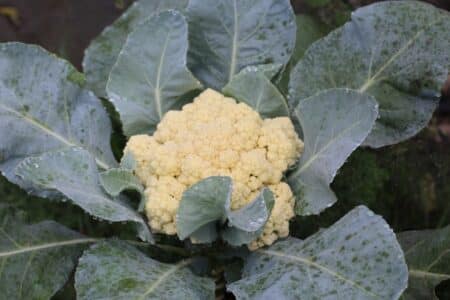
Many people don’t know that the edible part of a cauliflower plant is a flower head removed before it blooms.
When the plant forms the primary head, vegetative development stops. All of the plant’s nutrients are delivered to the main flower head at the top of the stalk to ensure it reaches its optimum size.
The blanching process can start when the head is around 3 inches in diameter. This process involves tying the outer leaves together with a rubber band or twine to cover the head and protect it from the sun. The creamy white color is achieved through this process.

Harvest
Unlike broccoli, which grows multiple side shoots, cauliflower only develops one head. Once the heads are 6 to 8 inches or roughly ten days after blanching, the crop is ready for harvest. At this point, the main head is tight and compact, and the florets are an even, pale white color.
Cut the stalk just 6 to 12 inches below the head to harvest. In most backyard gardens, the life cycle ends when the gardeners harvest the head; however, if the plants are allowed to continue to develop, they will mature to the next stage.
Flowers
When soil temperatures rise, hormones in the plant trigger cell elongation or stretching, causing the florets to grow tall or leggy. The plant becomes bitter and inedible.
This blooming process is commonly known as bolting or when the plant attempts to produce seed at the end of its life cycle. At this stage, the cauliflower will grow taller; the head will separate into blooming florets.

Seed Production
After pollination, the blossoms produce seed pods carrying genetic information. Once the seed pods have dried, gather the stalks to collect the seeds.
Death
Seed development is the final stage of a life cycle. The newly formed seeds have used almost all of the resources set aside by the cauliflower plant for development. At this stage, the plant deteriorates and dies.