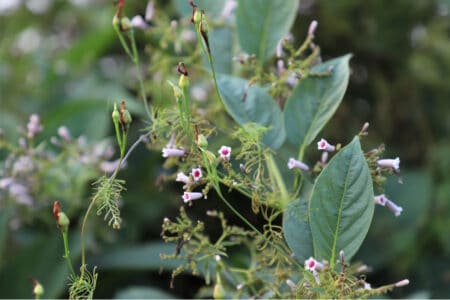
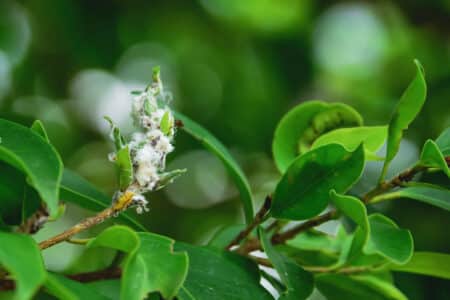
I remember inspecting my rose bush one day and seeing a brown, corky growth at the base of it. It was spongy-looking and bumpy. It was about the size of a quarter and was completely encircling the stem. Quite honestly, it was gross.
But what was it?
If you’ve seen this before, don’t pull out the insecticide spray right away. It is not an insect or a fungus – it’s a bacterial disease called Agrobacterium tumefaciens, commonly known as crown gall.
Agrobacterium tumefaciens is a soil borne bacterium. Crown gall enters plants through wounds or natural openings in roots and stems, usually close to the ground. Mature plants can withstand an infection, but young plants can be stunted and weakened and less able to resist drought and other stressors.
This disease is found on over 90 plant species, including chrysanthemums, marguerite daisies, grapevines, raspberries and blackberries, wintercreeper (Euonymus fortunei), roses, rhododendrons, azaleas, maples, poplars, and willows.
Life Cycle
Agrobacterium tumefaciens overwinters in the galls on plants and also in the upper layers of soil.
The optional conditions for crown gall formation are in springtime when temperatures reach about 77°F (25°C), and there is rain or running water to splash the bacteria onto the plants.
Plants with fresh wounds of any sort send out chemical signals that invite the bacteria. Wounds can come from insects and nematodes chewing on roots, mowing, pruning cuts, grafting sites, frost injury, or string trimmer damage.
Once the bacteria enters the plant, it inserts a bit of its own DNA into the plant’s cells. This over-stimulates the plant’s growth hormones and causes the cells to divide uncontrollably, creating these tumor-like growths.
Galls can form all through the growing season. Temperatures over 86°F (30°C) slow the production of galls. Agrobacterium tumefaciens is dormant in both existing and decomposing galls and in the soil through the fall and winter.
Studies have shown that gall formation is more severe in alkaline soils than in acidic ones, indicating that pH could factor in this disease’s severity.
As the old galls die, the bacteria are returned to the soil. These bacteria can survive in the ground for 2 years and up to 15 years when decomposing galls are present.

Identification and Damage
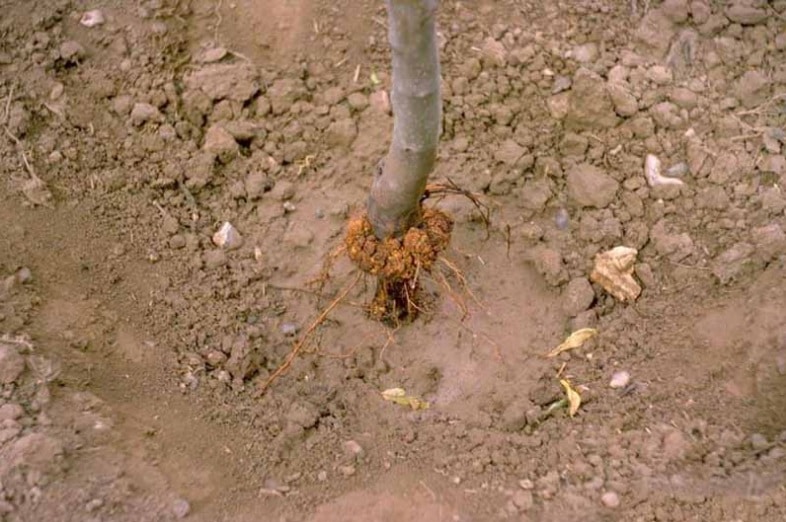
Galls are most often found on stems close to the ground (the crown or base of the plant), but they can also form on roots, trunks, and branches. Splashing water can carry the bacteria to any wound. Symptoms can appear as soon as a few weeks but can take as long as a couple years to manifest.
Young galls are round, yellow, and about 2 inches in diameter. As they mature, they become irregular in shape – looking a bit like a small head of cauliflower. Old galls are brown and bumpy and may have cracks and fissures. Galls can be hard or soft, depending on the plant tissue infected.
Large galls that completely surround a stem can limit the movement of water and nutrients but won’t usually kill a mature plant. Plants with large or numerous galls may be stunted and predisposed to drought injury and winter damage.
Suckers on trees are sometimes an indicator that galls are present.
Prevention
If the bacteria is present in your soil, it is difficult to prevent this disease. Avoid pruning when temperatures are between 77°F (25°C) and 86°F (30°C), especially when it has been wet or rainy to avoid the optimal conditions for crown gall to invade your plants.
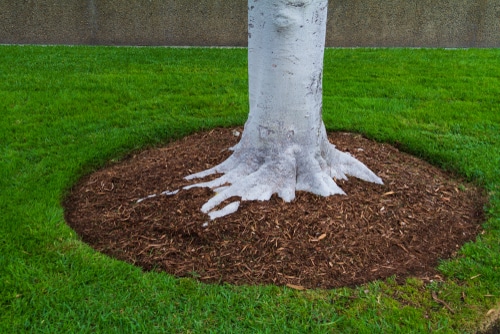
Don’t wound your plants. Protect trees from mower and stringer damage with a ring of mulch. Wrapping susceptible young trees with burlap in the winter can help prevent freeze damage.
Take care not to break or damage roots when planting. Root injury is a very efficient pathway for this disease to enter your plant.
When shopping, scrutinize the plants and don’t buy plants with signs of galls. You don’t want to bring this disease home with you!
Plant resistant species. The University of Illinois Extension Service lists the following species as more resistant to agrobacterium tumefaciens: “barberry, hornbeam, true cedars, ginkgo, golden raintree, tulip tree, mahonia, spruce, linden, boxwood, catalpa, beech, holly, larch, magnolia, black gum, pine, Douglas fir, bald cypress, hemlock, birch, firethorn, redbud, smoke tree, sweet gum, deutzia, serviceberry, yellowwood, yew, and zelkova.”
Don’t plant in heavy, wet soil, and never plant a tree deeper than it was planted at the nursery.
Control of Agrobacterium Tumefaciens
The best methods for controlling crown gall are preventative and cultural controls. Mature trees and shrubs can live with a small infection. Young plants are more vulnerable because they do not have the size and strength to overcome this disease, especially if the galls are girdling many stems.
Cultural Controls
If the galls are small and look easy to cut out, do so with care. Make sure your clippers are “extra-sharp” to make a clean cut. Sanitize your clippers between cuts with a solution of 9 parts water to 1 part bleach (bleach wipes also work well for this). Then dispose of the infected plant parts. Do not compost it.
Time this work for a dry day when temperatures are outside the optimal range for crown gall to develop – either below 77°F (25°C) or above 86°F (30°C). The cooler and drier the weather, the less chance the disease can spread.
If a plant is heavily covered with galls, the best solution is to remove and dispose of the plant. Do not plant the same type of plant in the same spot. This pathogen can survive for many years in the soil, so replant with resistant species instead.
Biological
Agrobacterium radiobacter K-84 is an antibiotic that is mixed with water and this solution is applied to the roots of susceptible trees and shrubs at planting time. This antagonist bacteria will occupy the wound, which means that Agrobacterium tumefaciens can’t!
This is not usually a practical solution for the home gardener. It’s mainly used by nurserymen and fruit tree growers.
Chemical
Unfortunately, there are no chemical controls for agrobacterium tumefaciens. Soil sterilization is sometimes employed, but this is not a practical option for the home gardener. The best practices are prevention, cultural controls, and resistant species.